Monday, April 5, 2021

Childhood Home

My first childhood home has retained a magical quality for me. We lived there from when I was nearly 6, to when I was 10 years old. Only five years, but somehow, that home has remained with me my whole life. In fact, just last week, it was in my dreams yet again. There is an innocence and fascination in that home, which is not in the homes that followed. The only thing I can speculate differentiates that home from the rest is the fact that I was always a child in that home - not a teenager or young adult, like I was in our subsequent homes. 

As often is the case with childhood memories, they are larger-than-life. We had a lovely 'playborhood' culture, a term that didn't exist at that time, because that's how all neighborhoods were - you stepped outside your home after school, found other kids outside, and voila, there was your 'play date.' My school best friend lived three houses down the street - we walked back the 0.4 miles from school home together with her Lolo ('grandfather' in Tagalog) every day from 1st through 4th grade. I don't remember my mother ever coordinating or confirming with their family that Lolo would walk with us after school. I'm sure there were days when we did the walk back ourselves without thinking too much about it. We had other friends in the neighborhood as well - our next door neighbor had three daughters, two of which were close enough to me and my sister's age. And my mother's best friend lived 4 houses down, around the corner. It was the home I would walk to if I came home from school and my mother wasn't home. If that aunty wasn't home, there was another aunty up the street and at the end of the court, a short five minute walk away that I could go to. In the era of landlines, this was the back-up plan. 

One memory that has fragments in my head is of this one particular evening: I think it was close to summer, because it was still bright outside and the kids had already gone in from our after school play. I don't know if my mother heard the sound of the accident itself, or the commotion that ensued afterwards - but we found ourselves outside on our sidewalk, along with all our neighbors as spectators. A car had come crashing into the house two doors down. One can only guess how that happened - taking a turn too fast and skidding out of control? It slammed into the pillar of the garage, and bricks lay piled on the crushed front of the car. I remember nothing further about this scenario, and wonder if my mother remembers this particular evening, as we observed this scene together. Was the driver ok? Were the members of the house ok? Now I can't help but wonder about whose insurance paid for what... 

Cutting to present day - we live in a ranch-style single family home that reminds me a lot of that first home. Size wise, this home is larger than our original home - but I was a kid, so that 1100 sq. foot house felt pretty big to me. We have the closest thing to a 'playborhood' one can hope for in a (sub)urban community these days - my son has friends in the house across the street, around the corner, and an aunty who lives a little further down the street. School is 0.4 miles away, and sometimes I chaperone the walk home with my son's school buddy. 'Sometimes' being the operative word - because aside from the fact that we aren't afforded the regularity of the same schedule every day - we are now in that unique circumstance that all children have been schooling from home for the last year. Our son finally went back last week, in time to experience the remaining nine weeks of third grade in an actual classroom setting.  

There are many parallels I often draw to my childhood in that first home and my son's childhood here, but that's a story for another day. Lately, I have been sleeping in the guest room of the house, because that mattress is best suited for my healing back. The guest room is the front most room, and the window looks out the front yard of the house. I can't tell you how many times I have thought of that car, crashing into the front of the home, and wondered - what if a freak accident like that happened one night when I'm sleeping in the guest room? It's a terrible, morbid thought, fueled by irrational fear and anxiety. And, of course, it stems from the image of the car wreck I witnessed 30+ years ago outside my home. 

It makes me think, just how powerful images, and feelings experienced in early childhood are. Of course, this is a whole huge topic, and the basis of all our human psychology. They shouldn't even call it 'child psychology.' Just psychology. Because EVERYTHING in your life comes back to your childhood. And I truly mean everything

And so I bring us to this weekend. Five young children, from the ages of 6-11, and a dog, experienced the magic of childhood in a way that has long been forgotten. They went on a hike in a (backyard) forest with their elder didi (15 years old), went off-path, and got lost. No cell phones, no adults, and they didn't know where they were. 

But they figured it out. They looked around, used land marks as clues, made rational choices, and found their way home. In the meantime, the parents had started wondering if they should be concerned that the hike had gone on for over 45 minutes, and started a search-party. Two of us walked to the exit point of the hike, shouted for them, and heard their excited voices in response (a relief, no doubt). In what I can only describe as exhilarated, I heard a young voice shout, "We just had a REAL adventure!!!" I smiled, my heart full, and took in this extraordinary, precious moment: a happy-ending after the brief uncertainty of which way this story would go. The remainder of the walk home, we heard the various accounts of the kids' adventure, each sharing in their age-specific way. The teenager, empowered by her leadership; the children, amazed by their resilience and deductive reasoning; and the group bonded together by an experience they all shared together. 

And so, the memory of this hike will grow with time. It will leave an indelible mark in their hearts, in the core of their beings, in the fabric of who they are, and who they will become. May we be able to give our children many more such adventures - where they find themselves in amidst the unknown, yet come out triumphant ... or at least come out the other end. 

Heading off into their adventure. The time stamp of this image told us how long the kids had been gone.

L to R: Nishad (9), Aarav (8), Rika (6), Risha (10), Simba, and Ria (11). Not in picture - Simran (15)                              


Friday, March 26, 2021

Why is slowing down so damn hard?

This week was the first week of a new session in my dance school, Antara Asthaayi Dance. We are still a relatively new school - we started classes in Mountain View in 2019. The usage of the first-person plural 'we' is something I am still getting used to. For the longest time, I felt such imposter syndrome when I'd be writing the marketing/promotion materials for AAD with  the word 'we.' There was no 'we.' It was just me, myself, I, doing this all. Happily, there are now three of us who are on the team at AAD. 

Starting a new class takes a lot of energy. The kids are ages 6-8, and unlike past classes, some of these children have barely attended kindergarten, thanks to the pandemic. Add to that, we're all wearing our masks and 80% of the energy I'm giving to the children is lost. I left the first class unsure - was that a good class? I had no gauge. 

I'm barely two weeks out from having thrown out my hip & lower back. I've taken efforts to get all the help I can - friends & family are cooking meals for me, my colleague is driving me to work, another is helping me teach the classes by physically standing in and doing the dancing for me. I am able to warm up the food for us, and do an occasional load of the dishwasher. But after teaching two hours in the evening, reaching home, getting dinner served on the table -- my body is broken like it has never felt before. I seriously can feel all my muscles on the brink of collapsing any minute now. And yet, I push just a little more - going to the toilet, filling my water bottle for my bedside, plugging in my heated blanket ... until my body collapses on the bed, wishing not to have to move for the rest of the night. 

I have a problem with slowing down. I feel like this injury came at a very opportune moment because as the world is starting to look like it's opening up, I am revving my engine at the start line, waiting for the green light to go  0-100 as fast as I can. 

And this is after all my repeated efforts over the years to slow my life down. Well, it's not slow enough. I took a look at my schedule for tomorrow, and it looks insane to me already: get myself dressed up, and the dance studio room presentable for a Facebook live dance event at 8:30am, Zoom into a book club, serve lunch to me and my son, take a taal class with my guru, teach one hour kathak on zoom, and go out to dinner with a friend in the evening. This sounds like a torturous day, I need to figure out what to remove. I will listen to my body tomorrow, and if I cannot do something, I will say no, and cancel. However sad it makes me to do that. Something's gotta give - and it will not be my body or health. 

So, I am percolating in my slowed down state of life -- really, it is much slower. Each evening, I'm in my bed by 7:30-8pm, and I don't fall asleep until after 11. I have 3-4 hours of solo time for myself, where I am reading, writing, thinking, creating, planning, imagining, fantasizing. A movie/mini-series project, episodes for my Patreon page, a new program in the curriculum of my dance school, contemplating non-profit status for my dance school, grants to apply for, prepping an upcoming AirBnB property ... all in various stages of development. Some will come to fruition - like the AirBnB property, and others will remain a figment of my over-active imagination for years to come - like the mini-series. But if it's about the journey, and not the destination, I'm glad to say I am enjoying this journey. 

Update: I managed to do all the activities on that overly packed Friday without further hurting my body. While I am glad that was the case, I will not use that as the metric of the standard of what all I can accomplish in a given day. I must continue to listen to my body, and make choices to move my life in a leisurely pace, where I can continue to enjoy the beauty of all the small moments.

The last agenda item on my packed Friday - dinner with my dear friend Farah. 


Thursday, March 18, 2021

Lesson learnt, point taken.

Remember all those times you swore you would never do 'said particular thing' again? In my 20's, the phrase usually came up in reference to a late-night out drinking. "Let's never drink again." If I could go back to my 20-something self, I would remind her that it's as simple as 1-2-3 - 1) drinking water, 2) filling yourself up on greasy fast food before you crashed, and 3) two Tylenols and one ibuprofen. When you wake up the next afternoon,, you're golden for your brunch mimosas. 
Hangovers - that was the big change going from your 20's to your 30's. “Newsflash - You had your first real hangover.” And then your second. And a third .... until you accepted that your body of this decade would regularly revolt against your insensitive judgements.
 
On a tangential thread, I recently read a fascinating best-seller called "Why We Sleep," written by a sleep scientist. Aside from the so many eye-opening (no pun intended) things I learnt about how imperative sleep is to our existence ... I also learnt that in the maturation stages of the brain, going from child to adult, one of the last areas to mature into adulthood is the area that makes logical decisions. That explains a lot of the choices I made in my 20's. 

Well, now I've hit my 40's, and am learning the next hard lesson of this decade. You cannot physically exert your body the same way you did before. 

Three years ago, the summer of 2018, I was leading my life at full throttle (as always). My newly formed dance company had been accepted into one of the most prestigious dance festivals this side of the Mississippi - the San Francisco Ethnic Dance Festival. I was training, choreographing, and musically conducting 9 dancers, 5 musicians, and myself for this world premiere at the prestigious 3,000 seater SF Opera House. It would be my biggest performance to date. Two weeks later, we were premiering an evening length show, self-produced, featuring 90 minutes of all-new repertoire that I was creating/composing/choreographing, and rehearsing 4-6x a week. In between this, I also met with social media superstar kathak dancer Svetlana Tulasi for a brief 24 hour period, where we choreographed, and shot a music video - immediately after which we both parted and rushed off - myself to another 4 hour rehearsal with my musicians, and she to a 3 hour workshop. 

When you're going full-speed, everything is extreme. Your highs are high, and your lows are low. Being on that grand stage was one of the finest moments of my life. I had never seen an auditorium of that grandeur - at least not from the vantage point where I was standing then. I looked out to the audience, and kept looking higher and higher - it was as if the audience reached all the way to the sky. 

I also remember one of the two days of the SF Ethnic Dance Festival performances, I had a terrible depression. The kind where you can't bring yourself to get out of bed - let alone drive 50 miles, do hair/makeup for seventy minutes, and then dance as if you owned the stage for twelve minutes. I remember a distinct moment, when we were in the last one minute of our performance. I had one last set of spins left, and then the finale. I was so tired. Not because a lack of stamina - I was just tired of talking, smiling, guiding my students, making pleasantries with my colleagues, and going about this spectacular day in the most professional/personable way I could. In that split second moment, I chose to "cheat," and do one less spin than the piece advocated for. This may sound silly to you, but for me, it was indicative of a debilitating state of mental health. 

And it's no surprise when you're pushing so hard, that both your mental health, and your physical health suffer. 

We finished both those concerts that summer, and my teaching calendar suddenly was wide open without any major rehearsals. Always needing to keep pushing myself to the brink, I decided to do a 30-day Facebook Live footwork practice something-or-the-other, where I’d share a live practice session of about 20 minutes of intense footwork each day. Thinking back, this choice was made out of fear. Fear that if I don't have an upcoming performance, I will fall out of regular practice. 
Now, I can't remember if it was already starting to hurt, but I have a recollection that in the first week of this footwork challenge, I carried my then six year boy in my 'godi.' As moms, we all hold our kids at the strangest of angles, while multi-tasking other things. My son was probably close to 50+ lbs, but more problematic was the fact that he was 2/3 my height. It is very imbalanced to hold something heavy that is almost as big as you. 

I strained my left hip. The piraformus. I quit my Facebook footwork series within 8 days, feeling like a complete failure, and berating myself for how weak I am. I don't even know what happened for the next year, but I must have gotten used to a low level (like, 2 out of 10) pain in my left hip. Each time I would amp up dancing (usually before a performance), the pain would come back. This pattern continued until 2020. 

I threw my back out for the first time in 2020, a week after the Shelter-in-Place order. Like the rest of the world, I had to switch my work to Zoom, and I taught hours of Zoom kathak classes sitting in my bed, because the other desks in the house were taken by my son and husband. Throwing out my back was one of the scariest experiences ever. I panicked when I found myself STUCK. Like, I literally could not move, and even a slight centimeter of movement caused pain beyond belief. Like, contractions-labor-level-pain (that is always my metric for pain, bc that was seriously the craziest pain I have ever experienced). My cousin-in-law, who has thrown his back out several times, came to my virtual rescue, and taught me exercises to get out of my stuck. My physician cousin prescribed me ibuprofen and muscle relaxers. I had learnt my lesson - I would never allow myself to get to this point again. 

Never say never. 

Cut-to, exactly a year later. In the last 12 months, my back has gotten to the "almost thrown out" stage at least 3x. Each time, I would slow down, do my physical therapy for a few weeks, and then go back to my normal life. 
The same thing happened two weeks ago. I slept on a soft mattress, and then tweaked my back while showing my students how to do pushups with proper posture (irony at its best). My back was on the verge of getting thrown out - so I took my standard precaution, and slowed down for about a week. Then it felt better, and I amped up my practice and did 4 solid practices in a matter of one week. I was feeling sore after the last practice, and did yoga the next morning - and after a seemingly innocuous downward dog, it happened. 

My body said a big "Fuck you" to me. 

My left hip completely seized up. I couldn't stand. For THREE DAYS. Each time I would stand, an acute pain would emanate from the exact place my original injury of three years ago, and it would spread. Within 30 seconds, the pain would be so much, I would have to sit down, and could feel my thighs spasm for several minutes afterwards. I couldn't sleep, because there was no position in which I wasn't in pain. And from a mental point, I was bored, depressed, and freaked out. My fatalistic thinking took over - what if I could never dance again? It worried me that the pain had not reduced in these first few days - that this time I had really messed it up in a permanent sort of way. But, fortunately for me, on the third day, the pain became ever so slightly less. Over the next few days, I could stand for a few minutes at a time, and stretch a little. I could feel that the pain was just the same little hip injury from 3 years ago, screaming and shouting at me to take care of her. 
 
I am allowing myself to feel the reality sink in. I'm in my 40's, and I have to do things differently. In my 30's, I had to be mindful of alcohol consumption. In my 40's, I have to be mindful of physical exertion. I CAN still do the physical work as my 30’s - but with all the work that comes along with it. 

I have finally gotten a physical therapist, who will be my regular BFF now. Seriously, bc I will be seeing more of her than most of my own friends. Nowadays, there are all these cool apps that help with accountability of doing your exercises. Last time I was in PT, they were still sending you home with photocopied worksheets of what stretches you needed to do. I probably don't need to tell you that I lost those sheets even before I made it home. 

I suppose my 50 year old self would be looking back at me and saying, it's as simple as 1-2-3: 1) warmup, 2) stretch 3) Self-care i.e. REST. Well, I hope I can heed the wise advice of the 'been-there-done-that' version of myself. No, I change that. I'm not going to hope. I AM TAKING THE ADVICE. Three years of ignoring an injury deserves at least three months of my full attention. And so, I focus on fully healing. Once I am healed, I continue to strengthen. My 40's body will allow me do my dance as I wish, just as long as I remember to do the needful. 

Teaching kathak at the park, while seated. 


Monday, March 8, 2021

Perspective


Today is International Women's Day. I only know this because a bunch of people sent me texts wishing me. I'll be honest, it's not a day that has had much importance to me. It just feels like another one of those days that they have created in the calendar. Like National Chocolate Chip Cookie Day. Ok, not a fair comparison, but you get where I'm coming from. 

When I saw the texts from folks, the first thought that came to mind was, "Oh, I should probably post something about this also." This refers to posting on my social media for Antara Asthaayi Dance. It really wasn't coming from the heart at all, and I had accepted that I wouldn't be partaking in the commemoration of this important day. 

Then at my weekly meeting, my team member presented me with this:


I immediately loved it, and the image/message sent my neurons firing away, sparking a desire to tell my story, whatever that was. 

I composed a short message for my Facebook/IG that touched upon my train of thinking - the irony that kathak is performed and preserved predominantly by women, yet our gharanas (schools) are all headed by men. This thought came to me because I was recently teaching my little girls about the Lucknow gharana, and explaining how it was father who passed it on to son, and he onto his son, etc. I added how women weren't really a part of this, because they were expected to get married and have kids. Even saying the words just felt so strange. I'm sure (and hope) it felt totally alien and incomprehensible to them as well.

Further exploring the importance of this day, a friend had shared a creative project with me, where she was listing out women geniuses. She pointed out how the word genius is almost never associated with women. Such a simple point, but so powerful. I started thinking about the women I would consider 'genius,' and struggled with it. I felt resistance when I tried to put Lata Mangeshkar in that category. She is a legendary singer with thousands of songs recorded, has received the highest honor given to any civilian in India (Bharat Ratna), received honorary doctorates from half a dozen universities and arts institutions - and yet I still asked myself, "But is she is genius?" Luckily, Oprah didn't cause that issue for me. No doubt, that woman is pure genius. I began pondering the women I would consider heroes in my life, or 'SHEroes,' as I believe they are called. Again, I struggled. 

I was in conversation with a colleague, discussing a self-help style book the both of us had recently read. At the author's suggestion of how to do a particular exercise, she rolled her eyes and said, "Yeah, that's such a white man's perspective ... not happening, next!" I stopped in my tracks. I had read the same thing, and responded in such a different way. Realizing I would not be able to conduct the exercise the way he had suggested, I took shame/blame on myself - because I was unable to do it the 'right' way. 

This idea of 'perspective' is not something that should be new, but it feels very new to me. Reading interviews with female filmmakers, I hear them share about their perspective on stories, and I find myself scratching my head wondering "what does that mean?" Why or how would a movie or TV show produced or directed by a colored woman be so different? 

Watching Padma Lakshmi's "Taste the Nation" helped answered that question for me. The first episode brought me to tears and a craving for a burrito, at the same time. I had never thought about how much of what we imbibe is colored by the perspective of the white man. And how that, in turn, shapes my own perspective of the world, and my place in it. 

So, I guess I can say, that I am starting to feel the importance of International Women's Day. But really, this needs to be more than just a day, or even a month. Just like the BLM movement, it needs to be a part of our day-to-day thinking. And I guess, that's why more women, and people of color, sharing their stories is so essential to our society. 

I've since added some names to the list of my (women) heroes: Oprah, Ellen DeGeneres, Michelle Obama, Tina Fey, Kamala Harris, Madhur Jaffrey, Padma Lakshmi, Sunidhi Chauhan, Sitara Devi, Gauhar Jaan, Zoya Akhtar, Saroj Khan, Mira Nair, Ruth Bader Ginsburg, Greta Thunberg .... and I will keep adding names liberally, as I continue my ongoing education of the incredible women of yesterday and today, while shaping the incredible women of tomorrow!  

Sunday, March 7, 2021

Filling up pages - a commitment to myself

 I am revisiting this blog after over five years. How I got to this place ... I'll highlight the relevant points. 

In 2014, I made a resolution: that I wanted to be an artist. I was surprised to find that exact blogpost where I made that commitment to myself. And that inaugurated a whole series of life-changing events, that unfolded over the next few years. I would tear down the current life I was living, and rebuild from scratch. It sounds like a figurative exaggeration, but it really isn't. I was forced to re-evaluate all of the closest people to me in my life - my husband, my parents, my sister, my Guru (not necessarily in that order), and most importantly, myself. Going a little further. back, I believe that my personal awakening began when I became a mother in 2012, which led to questioning who I am, which has in turn led to so many more, ongoing questions, answers, awakenings, and musings. 

2016 Christmas was when I found myself at ground-zero.  I thought I had hit the lowest point I could possibly go to, and then I would be knocked down further. It was one hit after another. My theme song for that time was definitely, "I get knocked down, but I get up again, you're never gonna keep me down." I can't believe I just referenced a non-Indian song. But, of course, I don't know the name of the song, or who sang it. That would be asking for too much from me. 

2018 was the start of the upswing. The good thing about being at the bottom is that the only place to go from there is up. And slowly, day by day, things started to get better. Sometimes you'd have a good hour. Sometimes a good day. Sometimes a good week. And it has now built to a place where I can say that we've had good years in our rebuilt life. 

Slowing down has been a big focus of mine. But, living in Silicon Valley in this era, even at my slowest, I felt like I was maintaining a slow jog, with an occasional sprint when too many things fell together at the same time. It's a great improvement from the maniacal headless chicken dance I did for so many of my years prior to 2014, but still not where I wanted to be, and I could feel it. 

2020 brought everything to a grinding halt. There was no choice about it. It was as if Mother Nature told the whole world - STOP. JUST STOP. STOP EVERYTHING, AND TAKE A LOOK AT YOURSELVES. 

And, oh, we definitely did. The Black Lives Matter movement erupted within three months of the Shelter-in-Place order taking effect. That has been one of the most profound looking glasses put in front of our faces. Racism was no longer a binary check box - racist or not racist. Now we were forced to look at all our implicit racial biases that influenced our thoughts, decisions, perspectives ... which would then effected our policies, laws, etc.

But on a smaller, personal note, I made the decision to do something for my artistic self in 2020. I joined an online master class called "Creative Mastermind." It was run by a college friend of mine, Srinivas Rao, whose Unmistakable Creative Podcast I used to occasionally check out - and I found that I enjoyed what he was doing: highlighting the lives and stories of people who decided to do something different, and make a life out of it. I decided to commit 1 hour a week for the next 12 weeks to just listening to whatever this course was saying it could help me do - develop systems and pr
actices for being my best creative self. 

The snowball analogy is the best way to describe how I have gotten to where I am now, a year later. That commitment slowly led to more reading, introspections, writing, realizations ... and it crept into all facets of my life. I realized I had been fearing to reach out to a wonderful and incredible artist I had had the opportunity to work with the year before (2019) - but now with the SIP order, I thought maybe he might have the time to teach me online? Best decision ever - as this has grown into a beautiful new relationship, and I have unexpectedly found myself in the loving care of a guru. I feel like a small plant, being well taken care of, but constantly poked and prodded to grow quickly and reach for the sun, moon, and stars. 

I left social media in August 2020, as a part of a 100-day challenge I was doing with the online creative network I had joined. Social media was impacting my mental health. In a random, given moment, when you'd scroll through your Instagram feed ... in five minutes, you'd see 20+ posts, and experience 20+ different emotions - varying from happy, sad, angry, envious, laughter, inspired, etc, etc. It's not to say those emotions are bad to experience,  but IT'S TOO MUCH. My mind cannot handle that many varying emotions in that short of a time span. And then be expected to go back to whatever mundane activity I was doing before that.

Removing social media was like detoxing from an addiction. It was a really well-timed detox, as I managed to survive the 2020 election season. It also led to reevaluating my relationship with my phone. 

Now, those who are close to me have often been frustrated with my relationship with my phone. From missing calls, to not having the ability to look up pertinent information bc I don't have my email on my phone -- my attempts at digital reduction were bringing in enough inconveniences that those closest to me (i.e. my husband) were left frustrated with my asinine methodologies. Reading the book "Digital Minimalism" helped me here by figuring out how to utilize technology to support the life that I want for myself - without being inconvenienced and inconveniencing others around me.

The life that I want for myself. That's a heavy question.  

By the way, in four months of not having social media in my life, I read more books than I had read in the last four years. That just shows how little I read in the years prior - not what a voracious reader I have turned into. Though, I must admit that I am proud that I have already read four books this year, and it's only the beginning of March! 

I've decided to continue with the rest of my life without social media. I have social media for my dance school/company, but not for me personally. The things that I liked about social media - feeling connected to others, and sharing my story. I will find better ways of supporting those two aspects in my life. 

I have been keeping a Bullet Journal since June 2020. I've always loved notebooks. I often would have something that I called "My Everything Notebook," which had everything from notes, to personal journal entries, to phone numbers, receipts, etc. Well, turns out someone figured out to make the everything notebook an efficient system of preserving and planning your life. I discovered that I also enjoy doodling and I'm not half bad at it, thanks to an unending supply of inspiration from Pinterest. Keeping a bullet journal has also reignited my passion for calligraphy and lettering, a passion of mine since I was ten years old. 

Writing is something I've always loved to do, and wished I did more of. So, I put the idea out there in the universe - I want to write more. I have become a believer in an almost simplistic approach to life - you put the idea out there, and then the universe revolves around to bring that idea to a reality. Call it the power of the subconscious, call it god, higher power, call it the force - whatever floats your boat. But try it - you'll be amazed at how simple it can be. 

I was approached by an editor to write a piece for their blog, "American Kahani." I was pretty flattered to be honest. I don't consider myself a writer by any means, though I have been paid for the craft in the past. And so, writing for that blog started turning the wheels even faster, as I further began to ponder, what is it that I have to say? 

With this post, I make a commitment to myself - to keep filling up pages. I hope that this goes beyond my morning pages (three pages of hand-written stream of consciousness at the start of each day), and bullet journal - but also to this personal blog, American Kahani, and my creative narrative writing - where I bring to life all the characters and stories that float around in my head on any given day.  


Wednesday, February 17, 2021

China Zindabad

 The following post was published in American Kahani


What Happens When a Socially Conscientious Citizen Loses Her Glasses

  • Looking at white privilege, carbon footprint, China, Amazon and the joys and horrors of hyperacuity.

I’ve had perfect 20-20 vision my entire life. I was one of those annoying people who could read the smallest font of the menu board from the entrance of the restaurant. I remember going to an optometrist, and as he looked at my eyes through the opthalmoscope, he asked me if I was vegetarian. “Yes,” I replied. He was pleasantly surprised. Apparently, non-vegetarians develop a plaque around their cornea, of which I had none. That’s how amazing my eyes were. 

Almost like clockwork, I turned 39, and I started losing that perfect vision. A slight variation in my vision makes me feel like I’m going blind. It is not acceptable to me that I can no longer identify which airplane is flying 1 mile high in the sky above me. 

I finally made it to Lens Crafters, and found out that I needed  reading glasses for far sightedness, and another pair of glasses for astigmatism, for nighttime driving and such. There was no way I was spending money on two pairs of glasses. Besides, I didn’t even know how much I’d really wear them. 

I surprised myself there — I loved my $200 Dolce & Gabana framed glasses. I couldn’t believe that I had allowed myself to suffer from such poor, impaired 19-20 vision for the whole last year. It was repeated moments of pure joy, each time I pulled out my glasses and suddenly saw the words in front of me the way they had been in my whole life before. 

As is expected for a first time glasses owner, I lost my glasses. I told myself I was lucky that they lasted the 7 months. Months later, I realized that I most likely left them at the AirBnb where I stayed on my last work trip (my only work trip of the year). Sheer laziness deterred me from contacting the AirBnb owner — I would just buy a new pair.  

Well, then Covid19 hit, and buying glasses became very low on the priority list. I’ll skip right ahead, 10 months into the pandemic, and I was sick of feeling blind all the time (again). A cousin suggested that I buy a pack of glasses from Amazon, and place them in various places around the house. A brilliant suggestion, no doubt. 

The hardest part of this purchase was getting the prescription from Lens Crafters. Due to patient confidentiality laws, they couldn’t tell me what my prescription was. “We can fax it to you.” Who the hell has a fax machine in 2021?! The store is literally around the corner from my home, so I finally walked in one day, and they handed me the magic number I was looking for: +1.00. 

I’ve grown up vegetarian, and the idea of nonviolence is something that suits my temperament. But in today’s day and age, there is no way to live a nonviolent life. Everything you do is hurting our planet.

Now, this is where I finally segue into the point of my story. I consider myself a socially conscientious citizen of the world — at least I try to be. My biggest concern and worry in every day life is the state of our beloved planet earth, and how each and every action I take (or don’t take), is further destroying our planet. In the event that I forget to bring my own reusable bag at the grocery story, I minimize my shopping so that I can carry all the goods back in my bare arms. The decision of “paper or plastic,” is too hard for me to make. “Neither,” is what the answer needs to be. 

Going against all my principles (including supporting local brick and mortar stores) I caved in, and bought the glasses from Amazon. $20 got me five — that’s right — not one, but five pairs of glasses, each with a matching cloth carrying case, and a cleaning microfiber. It was delivered within 48 hours of me clicking on my phone as I sat at the dinner table one night. 

I didn’t need to see the sticker to know where this product came from. “China zindabad,” I murmured, as I deliberated which color of frames to wear first — marveling at the convenience, simplicity, and luxury it afforded me.


Now here I am, ridden with the guilt of the carbon footprint my glasses have taken on the planet. One could argue that they had already been made, so I’m not really adding to destruction of the planet. But that argument is easily flawed — the more that we use, the more they will make. And I’m not even getting into the humanitarian atrocities of  the working conditions of the factories, or how old those workers were. 


I’ve grown up vegetarian, and the idea of nonviolence is something that suits my temperament. But in today’s day and age, there is no way to live a nonviolent life. Everything you do is hurting our planet. I once read an article that said that the shit we produce (literally) will leave a longer impact in the years to come than any of the actual ‘work’ we do. 

As I continue to ponder my role in ruining the planet, I am reminded that it is not only my generation that has caused this. I was reading a historical account of the 17th century Mughal Emperor Jahangir of India. He proclaimed with pride, the hunting conquests in his lifetime: 86 tigers, 889 nilgais, 1,372 deer, 36 wild buffaloes, 90 wild boars, 23 hares, 10,349 pigeons, 3,276 crows, 156 waterfowl, 41 sparrows, and 10 crocodiles — totaling 28,532 animals. This was one man, four hundred years ago. The looting and pillaging of our planet began well before my time. It is just now that it has exponentially grown, and the take-off point of the destruction of our planet has begun. Fires, floods, tsunamis, earthquakes, virus pandemics — abhi to party shuru hui hai (the party’s just begun). 

It’s a bit like the guilt of the white man, in some ways. ‘white privilege’ is nothing new —  it has been around for generations. And I use quotes around ‘white privilege’ not like the folks at Fox Channel who find it to be a fictitious, facetious concept. Quite the opposite, I have recently learned that this privilege is not limited to just white people. As a South Asian from a well-educated family living in Silicon Valley, I have been given so many privileges. Additionally, because I can easily throw myself in the BIPOC group, I don’t identify with the guilt of the white man. In a way, our community is worse, because we don’t even know that we’re exercising privilege, and straddling both sides as per our convenience. 

And so, our world continues its path into self-destruction — climate change, loss of ecosystems, racial inequalities, the poor becoming poorer, the rich becoming richer — eventually leading to more inequality and disruption in our day-to-day existence. Until then, I continue to harbor my love-hate relationship with China. To make myself feel better, I will not lose these glasses, and make sure they last me as long as my eyes remain at +1.00. 


Antara Bhardwaj is a Kathak artist and filmmaker based in Mountain View, California, where she lives with her husband and son. She runs a dance company and school by the name of Antara Asthaayi Dance. You can follow her on Facebook and Instagram.

Sunday, August 30, 2020

Interview with Smriti Mundhra on Indian Matchmaking

 The following post was published in American Kahani


“Indian Matchmaking” Wasn’t Made for a Western Audience: A Conversation with Smriti Mundhra

  • The creator and executive producer of the Netflix series discusses the show’s global popularity and if it propagates stereotypes and biases such as colorism, casteism among Indians.

Most of us have at least heard of “Indian Matchmaking” on Netflix by now. If not, check out my “Cringe and binge” review of the series last month. I am ceaselessly fascinated by ‘process’ when it comes to the creative arts and wanted to share a chat I had with the creator and executive producer of Indian Matchmaking, Smriti Mundhra. 

Smriti is a second-generation filmmaker. Her father was the illustrious filmmaker Jagmohan Mundhra, who is best known for helming biopics “Provoked” (2006 Aishwarya Rai), “Bawandar” (aka Sandstorm, 2000, Nandita Das), and “Kamla” (1984 Shabana Azmi). Smriti began her own journey as a filmmaker in her teen years. When most of us were trying to get fake IDs to buy alcohol or cigarettes, she was forging internships on film sets (reminiscent of Mae ‘Maeby’ Fünke a la “Arrested Development” no doubt!). She produced her first award winning feature film “Bomb the System” at the age of 22 and hasn’t looked back since. Earlier this year, still shy of 40, she received her first Oscar nomination for her documentary short “St. Louis Superman,” a film that becomes even more relevant as the BLM movement continues to grow. 

I wanted to chat with Smriti about her response to how “Indian Matchmaking” has been received, and to hear from her what her motivations were around this series that has sparked so many conversations in households across the world. Excerpts from the interview:

AB: “Indian Matchmaking” is the #1 series on Netflix in India, and in the top 10 in the U.S. How does it feel? 

SM: It’s been amazing and overwhelming. Maybe I was naive, but I was absolutely not prepared for this much interest and conversation, and the mania around the show. I’m glad it’s got people talking.

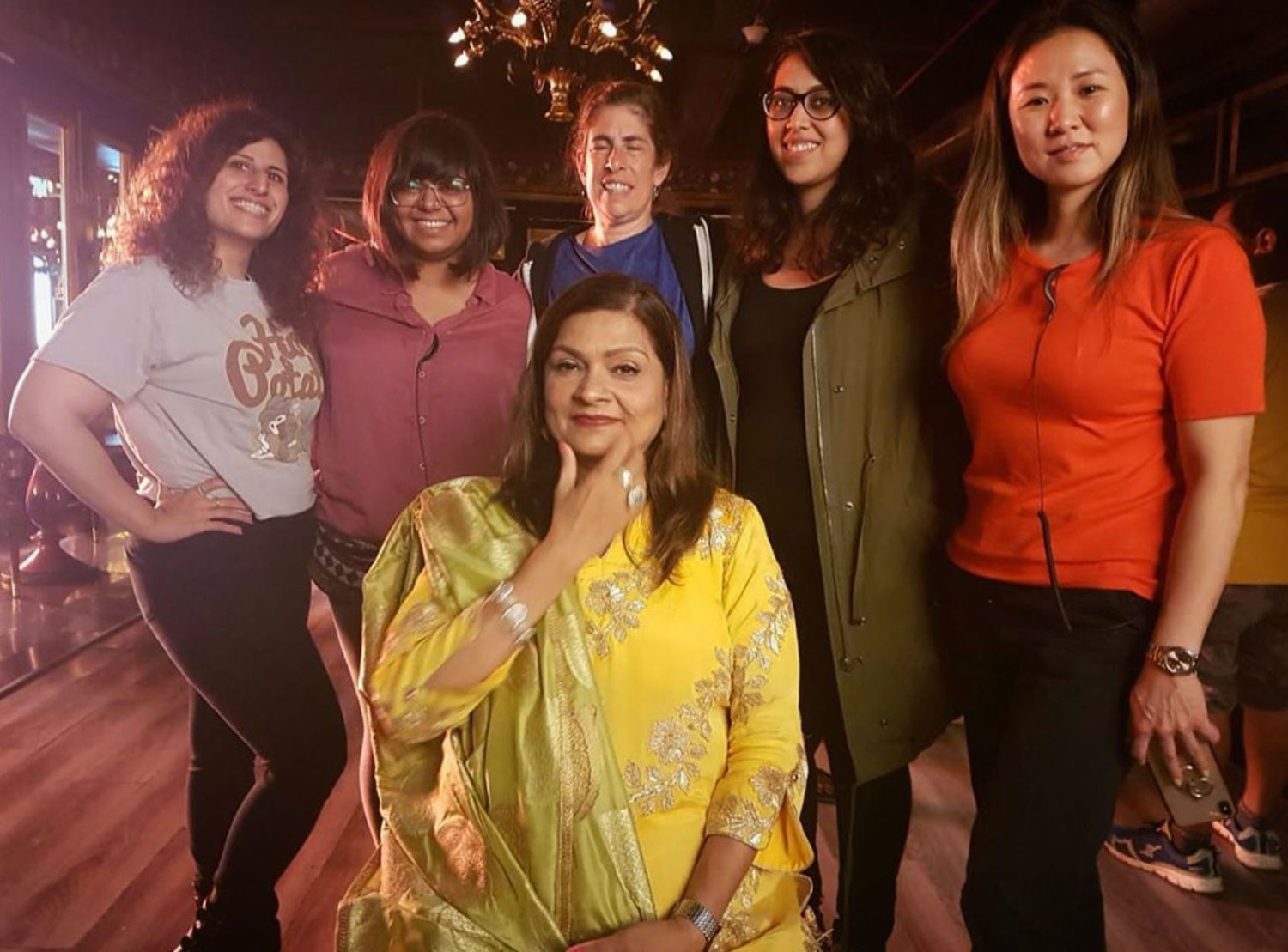
creator and executive producer of Indian Matchmaking, Smriti Mundhra. Top photo, Mundhra, second from right, with the “Indian Matchmaking” team.
PIN IT

AB: It definitely has a lot of people talking. Some people love it, and some people absolutely hate it. 

SM: I’m happy for all of the conversation. I was prepared for the critiques and the backlash as well. I think this is a super triggering topic that people have very strong opinions about. When you have something that comes out of India and reports to represent South Asian culture, and then it gets so big — there are going to be people who feel left out of it; that it didn’t cover their experience of this very broad topic of marriage and arranged marriage. That’s fair — I understand where that is coming from. I think the conversation and critique is really good. We made this show to start conversations. We wanted people to re-examine the things that we have ingrained in our society and our attitudes towards marriage for a really long time, and we don’t really talk about and quietly accept and tolerate. This show was made for an Indian and Indian diasporic audience. It wasn’t made for a Western audience. That also is a part of the conversation and makes it a little tricky. Because you have culturally specific content, that is available globally. How do you balance — who is your audience? Who is this for? So, when something like this blows up outside of the diaspora, in hindsight it poses all these questions — why didn’t you include this? Explain this? Why didn’t you talk about this? But we were making the show for people who wouldn’t necessarily need that context or explanation. We didn’t want to start from the place of making it for a Western gaze.

AB: One of the criticisms I have seen a lot is that the show propagates stereotypes, and biases such as colorism, casteism, etc. 

SM:  It’s not the job of the show to judge or critique. It’s not that type of docuseries. It’s a dating show. Our goal was to present the reality of this world as accurately as possible. And let the viewers be the critics. [Matchmaking] is a problematic system that does not work for everybody. There are people who deliberately move against it, and others who opt into it. We show that full range of experience and their interactions with the idea of traditional marriage. Sima comes from a very traditional stance. Her arc on the show is recognizing that she must also grow and evolve if she’s going to be able to successfully run a business. She has to be responsive to the demands and needs of her clients, that are changing. The clients are also demonstrating their dynamic between wanting to hold on to their traditional culture & identity, but also rubbing up against what feels problematic and saying their truths. The one thing we did try to do was make sure there was enough diversity in perspectives and ideology in the show, so that it wasn’t just a bunch of people desperate to get married, who will accept anything, or any critique. If there was any inherent commentary it was that – let’s show the tradition, as it authentically is, and show the new generation that is pushing back against that, as they authentically are, and let the people decide for themselves. We didnt try to consciously expose the flaws, but we also didnt try to hide any of them.

AB: As a filmmaker myself, I feel frustrated when I hear people refer to this series as a “reality show.” There is a distinguishable difference between reality TV and a docuseries, and I would love it if you could shed some light on that, and how it relates to this particular series. 

SM: For the most part, we’ve seen dating shows through the lens of “Reality TV.” “Bachelor,” “Too Hot to Handle,” etc. Those shows are much more heavily produced. They have an inherent framework or gimmick — whether it’s a bunch of people living in the same home competing for the same man, or whatever. [The producers] are casting people who are very well-versed in reality TV — models, actors, influencers type of people – people who already have or are creating a public platform. In a docuseries — yes there [is] an organizing principle. It’s a dating show about Indian millennials trying to get married — reconciling their progressive, modern, western beliefs or lives with their traditional cultural identities. In doing that, we wanted to cast real people who are going through this process. Not people who fit a certain physical type, or who are there for some kind of tokenized representation. And certainly, we were not casting for characters — like we need a hero, a villain, a victim, a shit-starter, etc. The only objective in casting was — let’s find the people who are the most open, authentic, and willing to be vulnerable. And within this somewhat narrow world of matchmaking, let’s try to push for as much diversity as we reasonably can. We don’t have a team of producers on the ground trying to manipulate people into creating drama. We tried to stay close to reality as much as possible. There was nothing emotionally manipulative about the show. It wasn’t like ‘This was actually a really good date, but we need to make it look like a really bad date for the show.’ We feel that there is inherently enough emotion and drama in the course of normal people dating that we trusted that would be enough to make a great show. Of course, it’s a TV show — it’s edited; it’s a narrow slice of somebody’s life. It’s never going to be a full, authentic representation of their full life and character. 

The author, Antara Bhardwaj, right, with Smriti Mundhra in Dubai, 2006 for the premiere of “Provoked.”
PIN IT

AB: Speaking of characters — I think it’s very commendable that despite all the responses, positive & negative, none of the cast members have spoken ill of the producers or the TV show. 

SM: I love our cast. The participants are amazing. Most of them hadn’t met each other or even knew who was on the show. But [now] they’ve formed almost a support group for each other. They’ve all handled it with so much grace and dignity. And this is another thing that is so different from being on a traditional reality TV — [those people] are expecting a certain degree of fame, and you invite that. When you’re on a show like this, they went overnight from being regular people to viral celebrities. No one expected the show to blow up as much as it has. Considering all of that pressure, it’s a lot to deal with — where the whole world feels like they have an opinion on your life. Especially for those who have been getting a lot of vitriolic comments — I am so proud of the participants of this show and can’t speak highly enough of them. 

AB: Do you have any favorites? 

SM: (laughs) I can’t choose favorites amongst my children! I love everyone in the cast. They are all incredibly real, honest, authentic people, who went along for the ride and were up for the adventure. They opened up and brought their authentic selves to the experience, and I love them all for that. I have a soft spot for Aparna because I can really relate to her. To me, she really symbolizes the reaction to what society expects of women. The way she reacts to some of those really unfair expectations – that women should be pleasant and conforming and conciliatory. Aparna is the manifestation of saying a big “F-you” to that. [Her viewpoint is] I’m a person that is ambitious, and successful and I got here because I’ve held myself to a very high standard, and I’m going to hold other people to that high standard – whether it’s a matchmaker, or someone I go on a date with.  I see someone that is unapologetically herself, but also self-aware, where she can think differently or grow into something new.

AB: The series left on a note that leaves the viewer speculative of Season 2. Is that a correct assumption? 

SM: We don’t know yet — it’s up to Netflix, and we’re still a little ways out before that [is decided]. 

AB: Is there anything specific you would want to do or show next time around? 

SM: The goal for me always, in everything that I do, is to keep widening the aperture of what we see in the world around us. As much as we pushed for diverse perspectives in this first season of IM, it’s still a very narrow slice of the South Asian experience. The goal is always to push for more… but it has to be done in an authentic way. Now that we’ve proven the model — that a dating show from a culturally specific view can work, that people are interested in it — I think we’ll have a lot more opportunity to expand what that world looks like in upcoming seasons – geographically, ideologically, culturally. 

For those who haven’t already seen it, do watch Smriti Mundhra’s directorial debut documentary “A Suitable Girl,” available on Amazon Prime. The film follows three young Indian women for four years as they go through the arranged marriage process. And you will see the story of “Sima from Mumbai,” trying to find a match for her own daughter as well! 


Antara Bhardwaj is a Kathak artist and filmmaker based in Mountain View, California, where she lives with her husband and son. She runs a dance company and school by the name of Antara Asthaayi Dance. You can follow her on Facebook and Instagram.

Equality on the dance floor (101-ish words)

I recently went out to a club/bar/lounge on a Friday night in a poppin' area. Yeah, that's not a sentence I say often. Oddly enough,...